Hidden Engineering: Hanging Veneer Supports
Welcome to our new Hidden Engineering series, where we reveal lesser-known and often unseen feats of engineering that surround us. Today, we’re taking a closer look at an interesting part of building design: Hanging Veneer Supports.
You may have noticed an architectural feature in many modern buildings: large glass curtain walls or building overhangs overlaid with brick veneer, creating an effect where the brick seems to float. It seems simple, but there’s actually a lot more design work involved than you might expect.
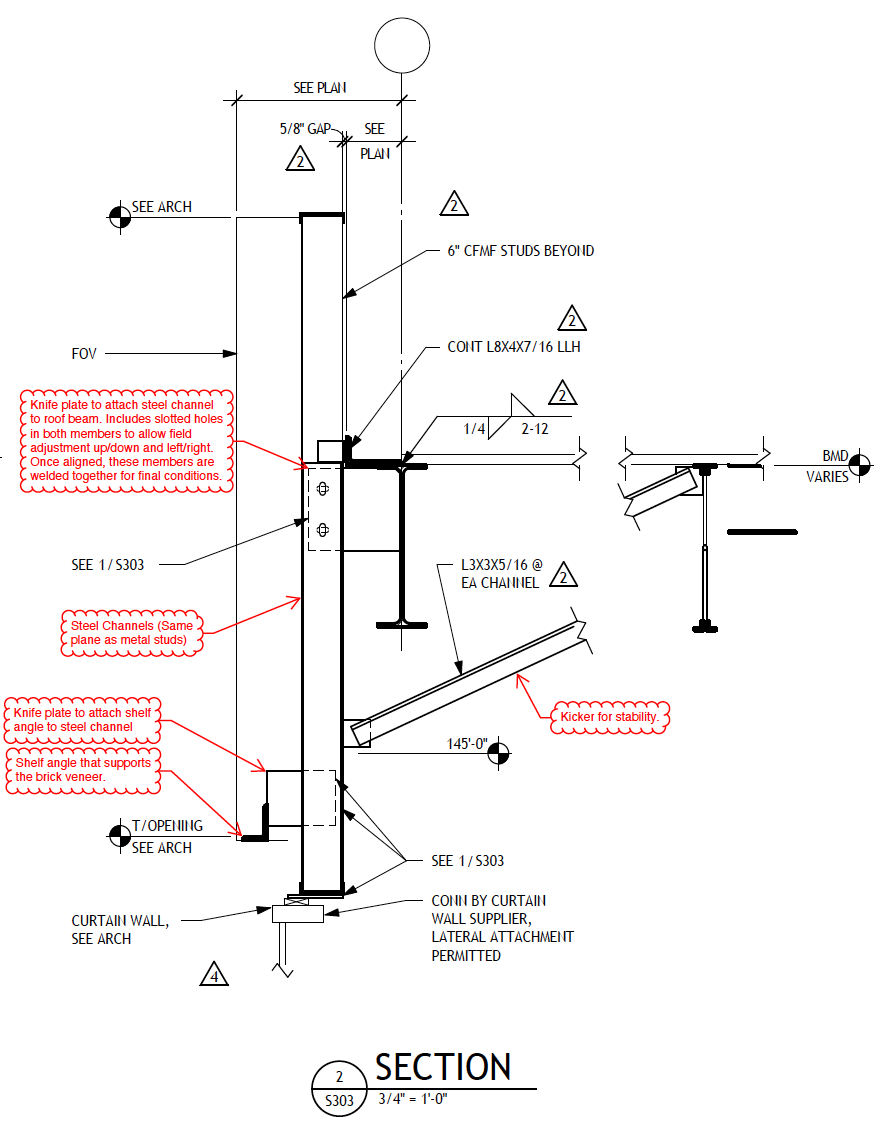
To hold up the elevated brick, steel channels hang from the roof or floor framing and line up with the wall studs. A shelf angle attaches to the steel channel, which supports the brick veneer. For stability, a kicker is added inside, usually above the ceiling so it stays hidden. The diagram shows how many extra steel pieces are needed to hang the brick, and these supports are placed every 48 to 64 inches around the building, matching the spacing of the studs.
Brick veneer is a brittle material, so to keep it from cracking, the supporting beam is designed to deflect less than it would for most other cladding systems. This beam already holds part of the roof or floor, and it also has to carry the weight of the brick veneer. To do this without cracking the brick, the beam needs extra stiffness, which means heavier steel. Additionally, when the brick is above a glass curtain wall system, the beam deflection has to be limited to prevent damage or cracking of the curtain wall.That’s why the beams around the edges of brick-veneer buildings often look larger than expected. You can see an example of this steel in Photograph 1, taken during construction at the CML Reynoldsburg branch.
The next time you admire a brick wall seemingly suspended by a glass facade, remember: there’s a hidden world of engineering holding it all together. Those sleek, seamless surfaces are only possible because of ingenious—and invisible—support systems working behind the scenes. It’s a remarkable bit of structural magic that turns an ordinary wall into an extraordinary feat of design.